Time
Research-informed answers and ready-to-use material, without hours of searching and reading.
BBE Buddy
BBE Buddy is an AI assistant for teachers and school leaders. It answers questions about teaching, learning and assessment from a curated collection of 136 works, shows the passage behind every claim, and turns the answer into classroom material you can export to Word or PDF.
The collection includes the EEF guidance reports, the National Curriculum for England and work by Dylan Wiliam, John Hattie, Paul Kirschner, Carl Hendrick and Efrat Furst.

Privacy
BBE Buddy processes personal data under the GDPR. To write an answer, the question and the selected passages are sent to an AI model outside the EU. The privacy policy lists every service that processes data, where it is located and what it is used for.
Benefits
Research-informed answers and ready-to-use material, without hours of searching and reading.
Every claim links to its passage, so you decide what to rely on and where to read further.
The collection is curated, so answers rest on established research rather than on whatever is popular online.
When the collection does not cover a question, BBE Buddy says so.
With your school's material added, answers use the terms and agreements your team already works with.
Classroom material exports to Word or PDF, so you can edit it and hand it out.
What it does
BBE Buddy answers questions, writes classroom material, and can work with your school's own documents.
Ask about formative assessment, feedback, questioning, cognitive load, curriculum or implementation. BBE Buddy searches the collection, selects the passages that apply and writes its answer from them. Every claim can be opened to show the passage and the work it comes from.
From the same conversation it writes nine kinds of material in full, aligned with what was discussed, and exports them to Word or PDF.
Policies, terminology and schemes of work can be added. Answers then follow your school's language and agreements, with the research collection underneath.
Process
BBE Buddy first searches the collection for the passages that answer a question, and then writes the answer from those passages. That is why every claim can be traced to a source.
Your question is matched against 136 works on learning and assessment, and against your school's own material if it has been added.
The passages that answer the question are selected and ranked. The open web is not searched.
The answer is written from those passages, with each claim tied to its source.
You open the basis: the claim, the quoted passage, the work and why it applies. Where the collection has no answer, BBE Buddy says so.
Example
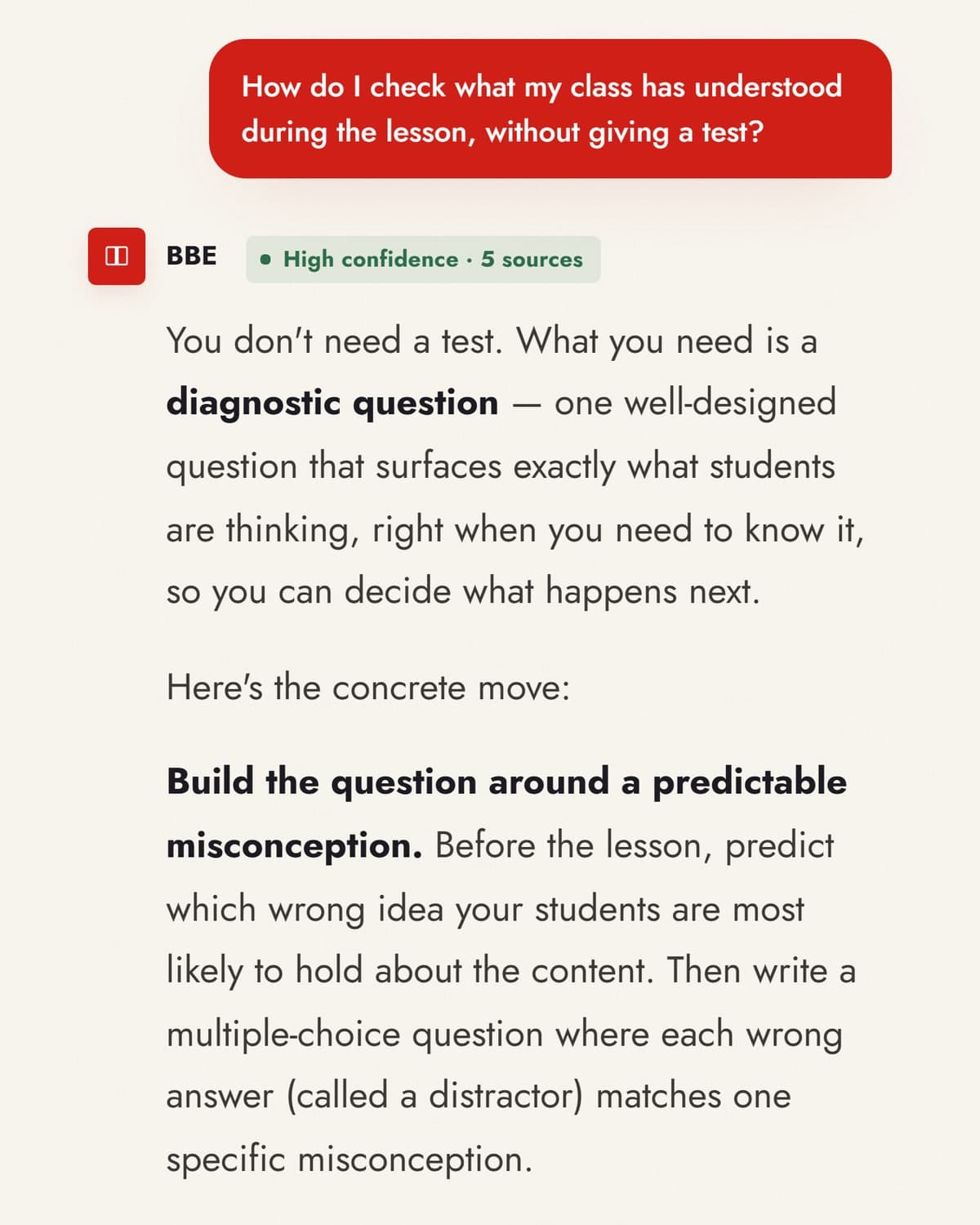
A real answer from BBE Buddy to the question how to check understanding during a lesson without a test.
Demo
This is BBE Buddy itself, answering from the full collection. No account needed.
Ask a question about teaching, learning or assessment.
The collection
Guidance reports, research and practitioner writing on learning and assessment, chosen one at a time and organised so the assistant can retrieve from them.
The EEF toolkit and its guidance on literacy, mathematics, behaviour and school leadership.
Dylan Wiliam on formative assessment, John Hattie on visible learning, Harry Fletcher-Wood on responsive teaching.
Paul Kirschner on cognitive load, Henry Roediger on retrieval practice, Efrat Furst on memory and understanding, Carl Hendrick on instruction.
The National Curriculum for England, primary and secondary, and David Didau on curriculum as a progression model.
A working library on diagnostic questions, rubrics and exit tickets.
Added on top of the collection.
Sources
A teaching assistant is only useful if you can check it. That is why BBE Buddy works within a fixed, curated body of evidence.
Plans
20 messages a day and the full collection from the first question. Upgrade when you need more.